This is a massive email I sent out over the past few weeks outlining the importance and potential (and really, the urgency) of maximizing the potential of your Google My Business, aka your Google Business Profile, as of late.
We all own them, but we’ve been utilizing them wrong for a while. One of our most valuable online sources of quality client acquisition has been severely overlooked. In any given market, Google Business Profile (formerly Google My Business) listings may get anywhere between 40-60% of the clicks in a search result for a local professional service. That would be more than double Google Ads and Local Service Ads, combined. It is also worth mentioning that the quality of the visitors is historically better, and some industries have 80% of their clients searching from their phones.
“Near Me” or “Close to Me” searches are up more than 200% in the past two years. 72% of consumers that did a local search visited a business location within 5 miles, and oftentimes much farther if the business had quality reviews. If you are not consistently showing up on Google Business Profile for your most important keywords, you are missing out on five times more views and twice the amount of actions as those that are consistently in those search results.
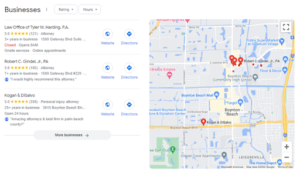
And for those that think they are always showing for the Top Three and have all their rankings where they want them to be, this is the part you will want to consider:
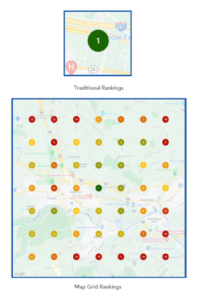
What you are seeing above is what happens to most of us when we search for our business, from our office, or close by. Or we peg our local ranking results to our exact zip or immediate area. We have peace of mind we are at the top, but if you look at the image above called “Map Grid Rankings” (which is pulled from an extended local tracking tool that we use for these campaigns), most of the time our local ranking drops off immediately via an extended radius. This means that if you searched a mile away, or even 6 blocks from your office, you may completely drop off of results. Imagine how many more people would see your GBP if it was extended even another mile in every direction. The outcome is exponential. 2024 will not only continue to be about getting your Google Business Profile up with quality reviews, but also extending the reach of your listing far beyond your backyard. Your GBP doesn’t have to show up for a select radius. It turns out there are many techniques that naturally extend your visibility and reach over time. And that’s exactly what MMM can do for you. In the past 3 months, we have brought on a team that has generated high-visibility, high-reach rankings for a national brand with over 1,000 locations. And we are applying that strategy to our clients’ Google Business Profiles.
Google Business Profile
Google Business Profile, also called Google Maps, Google Local, the 3-Pack, etc., has become a crucial centerpiece for lead generation for a local business. With the gradual loss of interest in LSAs and Google Ads, along with mobile searches and social validation, has kept on pushing the usage of Google Business Profile consistently over the years. It is not uncommon for survey after survey to come up with GBP accounting for a minimum of 40% of the click throughs for short-tailed searches (with organic results pushing the other 25% or so). For our own clients, the numbers are unparalleled.
In a recent study of our own clients over the past year, between 60-70% of their organic first-time calls came from Google Business Profile. This number is unprecedented—all of this from a free Google product? It sounds too good to be true, but before anyone can say “because it is”, let’s go through all of the scenarios that could attribute to these numbers being inflated, via the questions I have received from team members and clients rightfully attempting to poke holes in these unbelievable results.
First of all, how can you even tell the calls/leads are coming from Google Business Profile?
We’ll start with the easiest and then work our way down. There are two options that we currently have: CallRail, which is our trusted call (and form) tracking platform that has proven to be spot on with tracking all lead sources, including organic. The second is Google Business Profile itself. There is a dashboard that Google provides.
Here are examples of what both look like:
When this is broken down, it will be replete with granular information such as time, duration of call, caller ID, and phone number. There are also filters in which you can designate what requisites would make the call “qualified”.
Google Business Profile provides data, albeit not as well organized or pretty. But in some ways, it is even more insightful than what CallRail and other tracking may offer. More on that in the next questions.
How do you know if the calls are coming from people that already know the firm name?
This is definitely a compelling question. If someone is online and knows the firm name already, are a significant amount of calls coming through the Google Business Profile and then being attributed as a qualified lead? The short answer is yes, there are definitely people that will come in that way and GBP will get the credit for it. The long answer is having the data to find out what percentage.
As you can see in the last image of the Excel screenshot, that data can be provided directly from Google. Under the headings of “Direct Searches” and “Discovery Searches”, Google defines these as being your branded vs. non-branded, respectively. Direct Searches will be counted when the search term used was the firm name or something very similar to the firm name (or an attorney). Non-branded would have been a search for a lawyer/attorney without using a firm name. For this particular client, you could say as many as 40% of the GBP searches they received were branded searches, which is quite high. After going through dozens of clients over a longer period of time (about a year), this number is closer to 20%.
That means that when our clients are receiving 60-70% of their leads from their GBPs, we can expect the number to be closer to 48%-56%, which is still outstanding.
If you look on Google Search Console for how impressions/clicks come in through the homepage of your website, you’ll generally see that the homepage of your website will get much more of its traffic from first-time visitors from branded vs. non-branded.
If the results for your clients are so heavy on Google Business Profile, does that just mean your organic SEO isn’t working as well since it’s all relative?
This may be the case for some campaigns that are just getting their start, and the client has their GBP get traction before their long-term SEO and Content Marketing strategy. Organic results have a journey when it comes to rankings—getting from page 5 to 3 to 2 to 1, from the first page 8th position to the 5th to the 3rd, 2nd, 1st. You get the point.
When it comes to GBP, proper optimization can fast-track you to the 3-pack. This would create the impression of GBP being by far the leader in the lead generation. We’ve seen this for clients when they have 85% of their leads coming from GBP. We’ve seen from others that when their blogging and organic is doing very well, GBP is closer to 35%. But at 35%, it is still a respectable source of leads for this particular campaign.
We can’t assume every person has a preference for GBP searches. On average for a short-tail search, 20-25% of people will pass Local Service Ads, Google Ads, and Google Business Profile for organic. And for long-tail searches, Google Organic is often the only available SERP type.
Is there an “SEO” or “Optimization” process that goes into this to make the profile show up?
There certainly is, which can include but isn’t limited to:
Citations
Data Aggregation
Local/Geo-Optimized Content on Your Website
Localized Link Building
A Review Generation Plan in Place
There are ways that your current SEO on your website and the optimization efforts for GBP overlap, but you’ll want a plan specifically on the local side.
What if I have trouble getting reviews? Will this affect the campaign?
It almost certainly will. While it seems that the correlation between quantity/quality of reviews is a bit lower than it was, say, 5 years ago, your placement is only going to look as good as the reviews that are relative to yours. For example, even if you rank number one on Google Business Profile for all of your keywords, if your review quantity and quality is significantly worse than number 2 and 3, then the chance of the average consumer contacting you will drop off significantly.
It is important to have a plan in place for positive lead generation, Google rankings or not, consumers will be looking at your reviews whether it’s because of an organic search or a word-of-mouth referral.
I already show up at the top when you do the searches, what else is there to do?
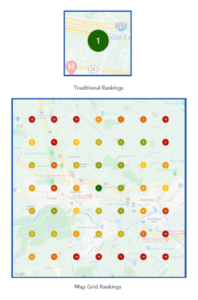
If you’re already positioned well for your local keywords, the next step is looking at how far those rankings reach. Let’s refer back to the image at the beginning of the post for this one:
Many local rankings only consider a ZIP code or an arbitrary point in a city. It is also important to use tools like LocalFalcon and LocalViking to have a grid ranking system to see at what point your placement drops off, because it will. Google doesn’t deliver a good experience showing a local business 12+ miles away from where the search is conducted. But maybe you can stretch your reach another 1-2 miles in every direction, which would be exponential coverage.
Can I pay for placement on these listings?
Occasionally you’ll see an “Ad” in the 3-pack, effectively pushing out to being a 4-pack. This is typically a local extension that is done with Google Ads. Though this technically means “Yes, you can pay for placement on these listings”, the Ad association is exactly what the average consumer just passed on the way down from LSA’s and Google Ads, so it stands to reason that the clickthrough for the Ad position on the 3-pack won’t be as useful. Also, if you already have a 3-Pack Position, you won’t be able to have two.
GBP doesn’t show up for every result, does that make it less valuable?
It doesn’t make it less valuable; it just means there’s a limitation to GBP being in front of every potential high-intent search that exists. It is the dominant result for short-tailed search (e.g. (city) (practice area) lawyer/attorney/law firm). It does show that an SEO campaign has to be diverse in creating different types of content such as blogs and articles to be in front of any potential valuable long-tail searches.
If this works so well, why wouldn’t I just open a million virtual offices?
If only! Google has made it tremendously more difficult to register virtual offices and get approval in 2022. Many times, you’ll have to verify using a video, signage, all the while speaking with a Google agent to prove its validity. In some cases, with the right team to systematically execute a tried-and-true process, you can make the strategy work while avoiding Regus, Opus, Da Vinci, WeWork, and other common generic VO companies. But it is incremental, and you can expect there to be delays and suspensions. Consider this Google’s modern-day equivalent of cracking down on SEO keyword stuffing and link building farms.
Maximize the Potential of Your Google Business Profile with Market My Market
More people search for businesses online than anywhere else, so it’s crucial that your company ensure your local business listing can be found on Google. At Market My Market, our content marketing and SEO experts will work with you to ensure you’re completely visible online so you can expand your customer base and, in turn, increase revenue. To discover more ways to elevate your marketing strategies, complete our online contact form or call us at (800) 997-7336.
The ongoing digital revolution is transforming the way that all businesses interact with clients and customers. Consumers rely heavily on digital channels for researching products and services and expect to make buying choices with the swipe of a finger. For organizations that want to remain competitive, having a defined digital marketing strategy and execution plan is essential for successful outcomes. With a demonstrated history of creating and implementing strategic digital marketing initiatives that drive growth, I am committed to delivering real, measurable results for my clients.
Dashboard. Flag defines if Two-Factor Authentication was passed.
Session
apbct_antibot
This cookie is used to distinguish between humans and bots. This is beneficial for the website, in order to make valid reports on the use of their website.
session
ct_check_js
Used in order to detect spam and improve the website's security.
session
ct_fkp_timestamp
Used in order to detect spam and improve the website's security. Does not store visitor specific data.
session
ct_has_scrolled
This cookie is used to distinguish between humans and bots.
session
ct_pointer_data
Used in order to detect spam and improve the website's security. Does not store visitor specific data.
session
ct_ps_timestamp
Used in order to detect spam and improve the website's security. Does not store visitor specific data.
session
ct_timezone
Used in order to detect spam and improve the website's security.
Session
apbct_cookies_test
Сookie to validate other cookies, so they can’t be spoofed.
Session
apbct_
Group of cookies which are set from backend and contain information about the current user
Session
ct_
Group of cookies used for storing dynamic variables from browser
Session
ct_sfw_
Group of cookies used for our SpamFireWall technology.
Session
spbc_cookies_test
Cookie to test cookies so we know that everything working properly
Session
spbc_firewall_pass_key
The flag defines if the Security Firewall was passed.
Session
spbc_is_logged_in
Dashboard. Flag defines if a user was logged in.
Session
CloudFlare provides web performance and security solutions, enhancing site speed and protecting against threats.
The _cfuvid cookie is only set when a site uses this option in a Rate Limiting Rule, and is only used to allow the Cloudflare WAF to distinguish individual users who share the same IP address.
session
cf_clearance
Whether a CAPTCHA or Javascript challenge has been solved.
session
__cfseq
Sequence rules uses cookies to track the order of requests a user has made and the time between requests and makes them available via Cloudflare Rules. This allows you to write rules that match valid or invalid sequences. The specific cookies used to validate sequences are called sequence cookies.
session
cf_ob_info
The cf_ob_info cookie provides information on: The HTTP Status Code returned by the origin web server. The Ray ID of the original failed request. The data center serving the traffic
session
cf_use_ob
The cf_use_ob cookie informs Cloudflare to fetch the requested resource from the Always Online cache on the designated port. Applicable values are: 0, 80, and 443. The cf_ob_info and cf_use_ob cookies are persistent cookies that expire after 30 seconds.
session
__cfwaitingroom
The __cfwaitingroom cookie is only used to track visitors that access a waiting room enabled host and path combination for a zone. Visitors using a browser that does not accept cookies cannot visit the host and path combination while the waiting room is active.
session
cf_chl_rc_i
These cookies are for internal use which allows Cloudflare to identify production issues on clients.
session
cf_chl_rc_ni
These cookies are for internal use which allows Cloudflare to identify production issues on clients.
session
cf_chl_rc_m
These cookies are for internal use which allows Cloudflare to identify production issues on clients.
session
__cfruid
Used by the content network, Cloudflare, to identify trusted web traffic.
session
__cf_bm
Cloudflare's bot products identify and mitigate automated traffic to protect your site from bad bots. Cloudflare places the __cf_bm cookie on End User devices that access Customer sites that are protected by Bot Management or Bot Fight Mode. The __cf_bm cookie is necessary for the proper functioning of these bot solutions.
session
__cflb
When enabling session affinity with Cloudflare Load Balancer, Cloudflare sets a __cflb cookie with a unique value on the first response to the requesting client. Cloudflare routes future requests to the same origin, optimizing network resource usage. In the event of a failover, Cloudflare sets a new __cflb cookie to direct future requests to the failover pool.
session
These cookies are needed for adding comments on this website.
Name
Description
Duration
comment_author
Used to track the user across multiple sessions.
Session
comment_author_email
Used to track the user across multiple sessions.
Session
comment_author_url
Used to track the user across multiple sessions.
Session
Google reCAPTCHA helps protect websites from spam and abuse by verifying user interactions through challenges.
Name
Description
Duration
_GRECAPTCHA
Google reCAPTCHA sets a necessary cookie (_GRECAPTCHA) when executed for the purpose of providing its risk analysis.
179 days
Google Tag Manager simplifies the management of marketing tags on your website without code changes.
Name
Description
Duration
cookiePreferences
Registers cookie preferences of a user
2 years
td
Registers statistical data on users' behaviour on the website. Used for internal analytics by the website operator.
session
Statistics cookies collect information anonymously. This information helps us understand how visitors use our website.
Name
Description
Duration
calltrk_nearest_tld
10 years
calltrk_landing
6 months
calltrk_fcid
-
calltrk_session_id
-
calltrk_referrer
6 months
Name
Description
Duration
_clsk
24 hours
_clck
-
Google Analytics is a powerful tool that tracks and analyzes website traffic for informed marketing decisions.
Contains information related to marketing campaigns of the user. These are shared with Google AdWords / Google Ads when the Google Ads and Google Analytics accounts are linked together.
90 days
__utma
ID used to identify users and sessions
2 years after last activity
__utmt
Used to monitor number of Google Analytics server requests
10 minutes
__utmb
Used to distinguish new sessions and visits. This cookie is set when the GA.js javascript library is loaded and there is no existing __utmb cookie. The cookie is updated every time data is sent to the Google Analytics server.
30 minutes after last activity
__utmc
Used only with old Urchin versions of Google Analytics and not with GA.js. Was used to distinguish between new sessions and visits at the end of a session.
End of session (browser)
__utmz
Contains information about the traffic source or campaign that directed user to the website. The cookie is set when the GA.js javascript is loaded and updated when data is sent to the Google Anaytics server
6 months after last activity
__utmv
Contains custom information set by the web developer via the _setCustomVar method in Google Analytics. This cookie is updated every time new data is sent to the Google Analytics server.
2 years after last activity
__utmx
Used to determine whether a user is included in an A / B or Multivariate test.
18 months
_ga
ID used to identify users
2 years
_gali
Used by Google Analytics to determine which links on a page are being clicked
30 seconds
_ga_
ID used to identify users
2 years
_gid
ID used to identify users for 24 hours after last activity
24 hours
_gat
Used to monitor number of Google Analytics server requests when using Google Tag Manager
1 minute
Marketing cookies are used to follow visitors to websites. The intention is to show ads that are relevant and engaging to the individual user.
CallRail is a call tracking and analytics service. Its script swaps the phone numbers shown on a page and stores the visitor's referrer, landing page and session ID, so phone calls and form submissions can be attributed to the marketing source that brought the visitor to the site.
This cookie allows the user to access the app with the correct permissions.
7 days
hubspotapi-prefs
This is used with the hubspotapi cookie to remember whether the user checked the 'remember me' box (controls the expiration of the main cookie's authentication).
1 Year
__hs_opt_out
This cookie is used by the opt-in privacy policy to remember not to ask the visitor to accept cookies again.
13 months
hubspotapi-csrf
This is used for CSRF prevention - preventing third party websites from accessing your data. Expires after a year.
1 year
__hs_do_not_track
This cookie can be set to prevent the tracking code from sending any information to HubSpot.
13 months
__hs_cookie_cat_pref
This cookie is used to record the categories a visitor consented to.
6 months
__hs_initial_opt_in
This cookie is used to prevent the banner from always displaying when visitors are browsing in strict mode.
7 days
__hs_gpc_banner_dismiss
This cookie is used when the Global Privacy Control banner is dismissed.
180 days
hs_ab_test
This cookie is used to consistently serve visitors the same version of an A/B test page they’ve seen before.
session
__hs_notify_banner_dismiss
This cookie is used when the website uses a Notify consent banner type.
180 days
hs-messages-is-open
This cookie is used to determine and save whether the chat widget is open for future visits.
30 minutes
hs-messages-hide-welcome-message
This cookie is used to prevent the chat widget welcome message from appearing again for one day after it is dismissed.
1 day
__hsmem
This cookie is set when visitors log in to a HubSpot-hosted site.
1 year
hs-membership-csrf
This cookie is used to ensure that content membership logins cannot be forged.
session
hs_langswitcher_choice
This cookie is used to save the visitor's selected language choice when viewing pages in multiple languages.
2 years
__hstc
The main cookie for tracking visitors.
13 months
hubspotutk
This cookie keeps track of a visitor's identity. It is passed to HubSpot on form submission and used when deduplicating contacts.
13 months
__hssc
This cookie keeps track of sessions.
30 minutes
__hssrc
Whenever HubSpot changes the session cookie, this cookie is also set to determine if the visitor has restarted their browser.
session
messagesUtk
This cookie is used to recognize visitors who chat with you via the chatflows tool. If the visitor leaves your site before they're added as a contact, they will have this cookie associated with their browser.
13 months
LinkedIn Insight is a web analytics service that tracks and reports website traffic.

 What you are seeing above is what happens to most of us when we search for our business, from our office, or close by. Or we peg our local ranking results to our exact zip or immediate area. We have peace of mind we are at the top, but if you look at the image above called “Map Grid Rankings” (which is pulled from an extended local tracking tool that we use for these campaigns), most of the time our local ranking drops off immediately via an extended radius.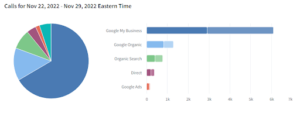
 Many local rankings only consider a ZIP code or an arbitrary point in a city. It is also important to use tools like LocalFalcon and LocalViking to have a grid ranking system to see at what point your placement drops off, because it will. Google doesn’t deliver a good experience showing a local business 12+ miles away from where the search is conducted. But maybe you can stretch your reach another 1-2 miles in every direction, which would be exponential coverage.