
At Market My Market, our team can now build websites and roll out site-wide edits for hundreds of clients in an afternoon, work that not long ago would’ve taken a department the better part of a quarter. Rankings, of course, still depend on strategy, content, and authority, which take time to compound no matter the tools. But on the build side, agentic tooling like Novamira and the proprietary MCPs and workflow application we’ve built around WordPress allow web development to move at a pace I still find a little surreal, and I don’t say that lightly. This industry has a long history of announcing revolutions that never arrive, so I’ve learned to be skeptical, but this is the real deal.
However, that pace has a darker mirror image, and it rarely gets discussed. The same speed that lets an agent work through a few hundred websites in an afternoon lets an attacker point their own agent at a few hundred thousand, testing every site for a way in before dinner. That agent doesn’t get tired, doesn’t take weekends, and doesn’t need to be particularly clever to find the one plugin that hasn’t been updated in months. That’s why going back to pure HTML is a real question again, and one we’re testing ourselves. And by pure HTML, I don’t mean hand-editing files over FTP. I mean a site that serves visitors plain, pre-built pages, with nothing on the public server for an attacker to log into or exploit. Returning to HTML isn’t an automatic yes. It depends on whether your platform is a deliberate choice or just a habit.
What’s Changed for WordPress Security?
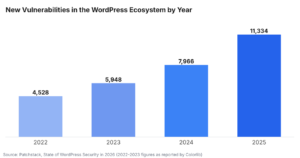
The WordPress side of this is well documented. Patchstack counted 11,334 new vulnerabilities in the WordPress ecosystem in 2025, a 42% jump from the year before, with 91% of these exposures sitting in plugins. Nearly half had no patch available by the time they were disclosed, and for the flaws attackers went after at scale, the weighted median time to first mass exploitation was five hours.
On most of the sites we manage, we run firewalls through Sucuri and Cloudflare, plus managed hosting and monitoring, and it all helps. But with the weighted median time to mass exploitation at five hours, no maintenance schedule keeps up, and the attempts will only multiply from here, no matter how good your last month was. Faster patching helps, too, and our own agents can push an update across hundreds of sites in an afternoon. But an update can only ship once a fix exists, and nearly half of these flaws had none when they went public. Speed on our side shortens the window. It can’t close it.
This summer made it concrete. A pair of WordPress core flaws, chained together into what researchers called WP2Shell, gave an unauthenticated attacker full control of a default install, and the researcher found the chain by pointing AI agents at the source code for just over ten hours and about $25 in compute. WordPress patched both flaws in versions 7.0.2, 6.9.5, and 6.8.6, but every site that didn’t update quickly was exposed. To be fair, because this is where these conversations tip into alarmism, the attack traffic that followed came from ordinary scanning infrastructure rather than AI agents. AI compressed the discovery and plain old automation did the rest, which is honestly the more sobering part, because none of this depends on hackers getting any smarter.
I’m hearing about alternatives in nearly every conversation now, from Node.js builds to platforms that market themselves as secure out of the box. Some of them are genuinely better architected, but anything that needs periodic updates, and especially anything running on a library of third-party extensions, keeps a door open somewhere. This raises a question I didn’t expect to be asking this far into my career: are we moving toward a full-circle return to pure HTML websites, the kind that sits on a server as plain files?
How We Built Websites Before WordPress
When I started in SEO, everything was in HTML. We used FTP to download pages, edited them locally (usually in Dreamweaver), and pushed them back up one file at a time. That meant that if a phone number in the footer changed, you changed it on every page that had a footer. We had to learn Joomla and Drupal along the way, neither of which was user-friendly.
And before anyone gets too nostalgic, static sites certainly weren’t immune. In 2009, the Gumblar malware infected computers and stole the saved passwords in FTP programs like FileZilla and Dreamweaver. Bots then used those passwords to log into the websites and insert hidden code into every page. Researchers found that some of the infected sites had no server-side scripting at all, so stolen FTP access was the only possible way in. Shared hosting was the other weak point, as one compromised site on a shared server could put every other site on that server at risk. The HTML itself was rarely the problem so much as the doors around it.
Why Nearly Everyone Moved to WordPress
WordPress won, for the most part, because nobody wanted to edit their website in Dreamweaver and go back and forth with FTP forever. It started in 2003 as a fork of b2/cafelog, a fairly obscure PHP blogging platform, and was built from the beginning to make publishing easy. Plugins arrived in 2004, and in 2005, version 1.5 added pages and themes, so a business owner could update content, change a design, and add features without touching code. For most of us, it was the first platform that was actually easy to use.
That ease is why W3Techs still has WordPress running just about 40% of all websites, even as its share has fallen from a peak of 43.6% in early 2025. The same data shows Elementor on 31.5% of WordPress sites and WooCommerce on 19.7%, and the official directory lists tens of thousands of free plugins. Every extension is a favor to the site owner but a liability for whoever has to keep it patched.
Why Speed and AI Crawlers Are Reviving the HTML Debate
Our team talked about HTML builds well before security entered the picture, mostly because of site speed. Speed has become a bragging point across the industry, with developers showing off sites that score 99 or 100 on performance, even when those sites look like every other AI-built site. Google’s John Mueller said in 2021 that Core Web Vitals are a ranking factor and more than a tie-breaker, though they don’t replace relevance. Google measures those vitals on real visitors’ experience, not on a lab score, so a 99 or 100 in Lighthouse is a sign of a fast site rather than a ranking boost on its own. Even so, if there’s a way to get there effortlessly instead of fighting a theme and a dozen plugins for them, we’re going to take it. The bigger concern was always the code bloat that comes standard in nearly every CMS.
The more important reason HTML is back on the table has little to do with speed and everything to do with who, or what, is reading your pages. Cloudflare data from June 2026 put automated traffic at 57.5% of HTML requests, the first time bots passed humans on its network. The crawlers behind ChatGPT and Claude also don’t render JavaScript, so whatever isn’t in the raw HTML may as well not exist to them. Many of the AI-built sites developers are showing off load their content with JavaScript, so they can ace a speed test and still be invisible to ChatGPT and Claude.
To be clear, this isn’t a knock on WordPress, which already sends finished HTML to every visitor. It’s a warning about the JavaScript-heavy builds often pitched as its modern replacement. Modern-looking isn’t the same as simple, and as bots, agents, and crawlers multiply, simple will keep paying off in performance, indexability, and crawlability.
Going Static Doesn’t Mean Giving Up the Login
The obvious objection to going back to HTML is that clients want to edit their own sites. A law firm, veterinarian, or dental practice may want to log in and change its own hours, for example, and that’s reasonable because a dashboard lets a front desk quickly update a holiday schedule, swap a phone number, or add a new provider bio without waiting on anyone. Going static doesn’t have to mean giving that up.
The pages visitors see don’t have to live in the same system you edit them in. In the setups we’re testing, a fast, static front end sits in front of a headless CMS. Most of the time that’s still WordPress, with the theme removed so it no longer builds the public pages. We keep the dashboard and editor everyone already knows. In some builds, it’s a different platform entirely. Either way, the person who needs to change the hours can still log in and change them. The CMS itself sits on a separate, locked-down address the public never sees, so a flaw like WP2Shell has nothing to reach on the live site. For everything else, the editing tools we’ve built around our own MCPs aren’t really WordPress tools, so they can be replicated for any platform, static sites included, and tooling that would traditionally have taken months to stand up can now be built in several days, sometimes hours.
Think back to the phone number in the footer that once meant editing every page by hand. An agent can now make that change across every file in a single pass. The result keeps the plugins, updates, and server-side code that attackers go after off the pages visitors actually load.
The Fair Case for Staying on WordPress
A one-sided case against WordPress would be the same kind of hype I’ve learned to distrust, so here’s the other side. Because WordPress runs just about 40% of all websites, its core gets enormous scrutiny, much like a standard operating system, and the record shows it. Patchstack counted only six vulnerabilities in core in 2025, all low priority, which puts the real risk in the extensions bolted onto it, not the platform itself.
That makes a lean, well-maintained WordPress site a defensible choice, even after this summer reminded everyone that rare isn’t never. So the real question for next year isn’t whether WordPress is dangerous. It’s whether you’re using it because it gives you peace of mind on security, performance, crawlability, and indexation, or simply because that’s where you’ve always been.
Static isn’t right for every site, either. An online store, a booking system, or a patient or client portal needs a live server behind it, and the contact and appointment forms on a static site still send their data to an outside service, which is one more vendor to vet. For a site that mostly changes its hours, services, and bios, though, static is a strong fit.
Full Circle, and Not Just for Code
The pull back toward the simpler, more human option isn’t limited to code. Content first leaned on AI for help, then for volume, and now the writing that stands apart is the writing that sounds the least like AI, which is why this post started as my own voice, transcribed, rather than a prompt. Graphics are heading the same way, because generic AI imagery all starts to look alike.
Companies that cut people in the name of AI efficiency are learning the cost. Forrester found that 55% of the employers it surveyed regret laying off workers because of AI, and Klarna’s CEO has said the company is hiring human customer service agents again because AI-driven support was lower quality. The lesson is that a business still needs a core group of people who bring their preferences, creativity, and individuality to the work, because that’s what humanizes a company and connects it with its audience.
Three Questions to Ask Market My Market About Your Website
A CMS like WordPress can still be the right platform next year, but the reason has to be deliberate now. Whoever builds and maintains your website, whether that’s us or another agency, should be able to answer three questions clearly. First, what are they doing to keep it secure against attacks that are automated, relentless, and never take a day off? Second, does your site consistently score 90 or above on Lighthouse and Core Web Vitals, and if it doesn’t, what’s standing in the way? Third, can they show you full indexation, clean crawlability, and how your site appears across LLMs and AI search?
If any of those answers come back vague, it may be time to ask whether the platform you’re on is still the one you’d choose today. Market My Market was named to the 2026 Inc. 5000 list of the country’s fastest-growing private companies, and our team is glad to talk through these questions with you, whether your site stays on WordPress or moves toward something simpler. Contact us to start that conversation.