
Two-Thirds of Consumers Can’t Name a Personal Injury Firm. Most of the Rest Named the Same One.
Personal injury law is one of the most heavily advertised categories in America. You’ll find it on billboards, daytime TV, bus benches, even stadium naming rights. So, in July 2026, we asked consumers a simple question with no prompting and no answer choices: name up to three personal injury law firms in your area.
Most could not name one.
This is not a piece with an enemy. It’s an observation of the state of consumer memory, trust, and behavior in the personal injury category, based on a national survey of 232 US consumers conducted through a paid third-party research panel. After a data quality screen on the open-ended responses, our working sample is 188 respondents. The findings cover what consumers remember, what advertising actually buys, what they look for on a firm’s website, and where they search.
The Recall Vacuum
66% of consumers could not name a single personal injury law firm in their area. Only 34% produced even one identifiable firm name unaided. For a category that spends billions on awareness, two thirds of the public draw a complete blank.
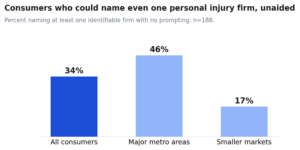 The gap between markets is the sharpest split in the dataset. In major metros, 46% of consumers could name a firm. Outside them, that falls to roughly 17%. Consumers in places like Des Moines, Syracuse, Boise, Amarillo, and Shreveport overwhelmingly start from zero brand memory.
Here is the part that matters for firms in those markets: smaller-market consumers search exactly the same way metro consumers do. They exhibit the same Google-first behavior and the same reliance on Business Profiles and reviews, landing within a few points of each other on every channel we measured. They are not behaving differently. They simply have no name in their head when they start. Rural and secondary markets are community driven, and a firm’s association with its geography carries real weight there, but when an injury happens, the search behavior is identical and the field is open. In a major metro, a local firm is fighting for the 54% who cannot name anyone. In a secondary market, that number is more than 8 in 10.
One National Memory, and It’s Probably Who You Think
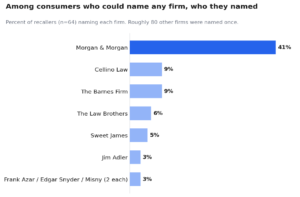
Among consumers who could name any firm at all, 41% named the aforementioned number 1. That is 13.8% of all consumers producing one specific firm’s name from memory, unprompted. No other firm cleared 10% of recallers, and the rest of consumer memory fragmented across roughly 80 firms named once or twice, almost all of them regional advertisers recalled only in their home market.
It is worth being honest about the scale of this. Extrapolated against the US adult population, unaided recall in that range represents tens of millions of people who can produce this firm’s name on demand. That is not law firm territory. That is H&R Block territory, the recall tier of national consumer brands, and it is a feat regardless of what anyone thinks of the advertising that built it.
Their positioning is a study in itself. Morgan & Morgan does not advertise as a good law firm. They advertise as the biggest, and in some executions, the biggest in the universe, complete with John Morgan floating in a space suit. The claim does something subtle: it pigeonholes every other firm in the country into the counterposition. The moment a competitor answers with “we’re not a big box firm, we give you personal attention,” they are playing on the board Morgan & Morgan built. Claiming “biggest” exclusively is the whole strategy. It forces the segmentation and lets them own the audience that equates size with strength.
And a meaningful audience does. When we asked whether a firm’s ability to maintain a presence across many mediums, TV, billboards, radio, online, says something about its ability to fight and win, 62% of consumers said yes or somewhat. Presence reads as capability for a majority, at least in part. Their messaging includes lines like “an army of lawyers.” Do you want your lawyers to be soldiers, or do you want them to be lawyers? Reasonable people can differ. But the messaging demonstrably works on a defined audience, and the recall data proves it.
Where Regional Recall Lives
Outside the one national name, consumer memory is intensely local. When consumers could name firms, they named the advertiser that saturates their own market, and almost never anyone else’s. We coded every named firm against the respondent’s own reported market:
| Market | Who owns unaided recall there |
| New York / Buffalo | Cellino Law and The Barnes Firm, the post-split duopoly, plus William Mattar upstate |
| California (SF, Sacramento, LA, Inland Empire) | The Law Brothers, Sweet James, Larry H. Parker |
| Ohio (Cleveland, Youngstown, Columbus, Cincinnati) | Misny, KNR, Elk & Elk: the deepest local recall bench of any state |
| Texas (Houston) | Jim Adler, recalled by both respondents by his taglines |
| Pittsburgh | Edgar Snyder, named by both Pittsburgh respondents |
| Detroit | Sam Bernstein, Mike Morse |
| Phoenix | Lerner & Rowe, Husband & Wife Law Firm |
| Denver / Colorado Springs | Frank Azar, named by both Colorado respondents |
| Kentucky (Lexington) | Hicks & Funfsinn, Gary C. Johnson |
| Philadelphia | Pond Lehocky, Lundy Law |
| Omaha | Hauptman O’Brien, Berry Law |
| Florida (Tampa, Orlando, Tallahassee, Naples, Ft. Lauderdale) | Morgan & Morgan, named by every Florida respondent who could name anyone |
The pattern is the finding: recall is either Morgan & Morgan or hyper-local. There is no second national brand in consumers’ heads.
The Advertising Paradox
So, advertising built the only recall that exists. Here is what it did not build.
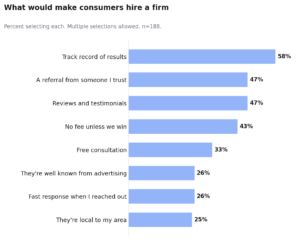
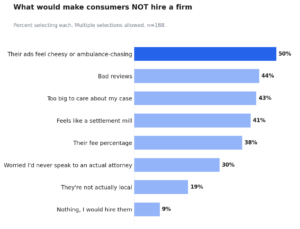
“Well known from advertising” ranks sixth of eight reasons consumers would hire a firm, at 26%. Track record of results leads at 58%, followed by referrals from someone they trust (47%) and reviews (47%). Meanwhile, the number one reason consumers would refuse a firm, selected by exactly half, is that their ads feel cheesy or ambulance-chasing. It outranks bad reviews. It outranks settlement mill vibes. Advertising in this category is simultaneously the engine of the only brand memory that exists and the single biggest stated trust killer.
Asked directly whether a firm that advertises heavily on TV and billboards comes across as more capable or qualified, consumers split: 41% said at least somewhat more capable, 43% said no difference, and 15% said less capable. The persuadable middle is real, and so is the backfire segment.
The approach behind most of this advertising is memorability at almost any cost, an earworm strategy that regularly tests the limits of state bar advertising and ethics committees. And here is the discipline the data imposes: we have honestly never seen a personal injury commercial we respected or enjoyed. That is irrelevant. Marketing collateral, branding, website aesthetics, and messaging are not for the marketer or the managing partner. They are for the ideal client persona. This is exactly why consumer research of this kind matters. Unless a firm is truly marketing in its own image out of ego, the community’s voice is the one that counts, and half of this community just said the prevailing aesthetic alienates them. That is an aggregate number, and tolerance varies meaningfully by market. But it is something every firm buying media should sit with.
One more paradox inside the paradox: 43% of consumers said “too big to care about my case” would stop them from hiring a firm. That is perception, not headcount, which is precisely why size signals fall flat elsewhere in this survey. Big-firm distrust is real and exploitable, but the trap is answering the “biggest” frame directly. The firms that win against it do not argue about size. They demonstrate the things consumers actually hire on: results, reviews, and responsiveness.
A note on fees, as 38% of consumers flagged the fee percentage as a reason not to hire. Contingency structures are heavily shaped by state bar rules, but we are seeing more movement here than the industry admits. We recently saw an Atlanta firm advertising 30 to 33%, below the standard cut, as an explicit selling point. Like every other professional service, pricing eventually becomes a differentiator. Contingency, flat fee, hourly: the structure itself is entering the marketing conversation.
The Homepage: Proof Beats Everything
We asked consumers to rank eight common personal injury homepage elements by what would actually grab their attention. We run conversion methodology, heatmaps, and CRO analysis on legal websites every day, but there is no substitute for asking people directly. Here is the consumer’s-eye view of the homepage:
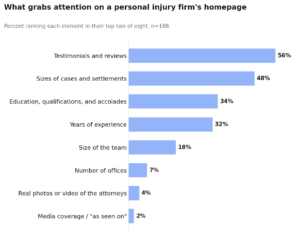
Testimonials and reviews lead (56% top-two), with case and settlement sizes right behind (48%). The bottom of the list is where the lessons live. Team size (18%), office count (7%), real attorney photos and video (4%), and media coverage (2%) barely register. Attention goes to proof of outcomes, not bigness signals and not humanization
The settlement number deserves an honest word. Consumers gravitate to case results because they case-match. We live in a what’s-in-it-for-me society, and a person rear-ended with a neck injury will scan your results page for the rear-end case with the neck injury, and no matter how prominent the disclaimer that past results do not guarantee outcomes, they will expect a similar number. Every lawyer reading this knows it happens. Its why results grab attention, and its why how firms present them carries real responsibility.
On the photo finding, one comparison from our research across professional services: consumers consistently tell us real photography does not win them, but fake photography can lose them. In our consumer research on dental practices, obvious stock photos were one of the most cited website turn-offs even though real photos ranked last as a decision driver. The same logic almost certainly applies here. Authenticity is a floor, not a differentiator.
Where They Search: Google, and a Surprise
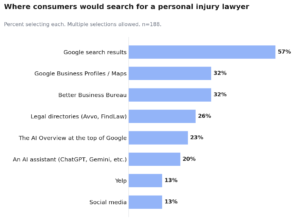
Google search leads at 57%, with Google Business Profiles and Maps at 32%. No surprises there, and it’s exactly why we treat local SEO as foundational rather than supplementary for firms in this space. The surprise is the Better Business Bureau at 32%, tied with Maps and ahead of the legal directories the industry actually optimizes for.
We will be candid: we think of the BBB as a last resort, a complaint venue, not a research destination. But that’s exactly the point. Take the gravity of a personal injury situation seriously and the number makes sense. These are consumers about to trust someone with a life-altering claim, and a meaningful share of them want to see whether there is formal discipline or a complaint history before they call. Our own prior consumer research found that people spend up to 30 minutes researching a lawyer before contacting one. Thirty minutes is a lot of surfing. It is enough to get well past your homepage and into every profile you have never claimed and never look at. Almost nobody in legal marketing manages BBB presence. A third of consumers just said they look.
On AI: 23% would consult the AI Overview at the top of Google and 20% an AI assistant directly. Meaningful, but the more important lens at this stage is not AI as the first search. It’s AI as branded information. What these systems say about a firm when a consumer ask is becoming part of the firm’s brand surface, and that representation layer deserves attention now, before the first-search behavior catches up.
What This Means
The recall vacuum, the advertising paradox, and the homepage priorities all point to the same set of priorities for firms competing in this category. Here is what the data says to act on.
- The field is open, especially outside major metros. Two thirds of consumers, and more than 8 in 10 in secondary markets, meet firms for the first time at the moment of search. Rankings, Business Profiles, reviews, and intake speed are not fighting brand memory. For most consumers, they are the whole game.
- Do not answer the “biggest” frame. Big-firm distrust is real (43%), but arguing size on any terms plays the national advertiser’s game. Demonstrate results, reviews, and responsiveness, the top three things consumers actually hire on.
- Lead the homepage with proof. Reviews and case results own attention. Present results knowing consumers will case-match against them, and present them responsibly.
- Market to the persona, not the partners. Half of consumers say the prevailing ad aesthetic repels them. What the firm likes is irrelevant. What the community responds to is measurable, and worth measuring in your own DMA.
- Claim and manage the profiles nobody watches. A third of consumers check the BBB. Thirty minutes of research reaches every corner of your presence, not just page one.
- Watch the AI representation layer. One in five consumers is already asking AI systems. What those systems say about your firm is brand surface now.
These shifts are part of the broader playbook we laid out in How Law Firms Will Win in 2026: the firms that adapt fastest to how consumers actually search and decide will be the ones that pull ahead.
Contact the Consumer Trend Specialists at Market My Market
At Market My Market, we communicate consumer trends and prove the viability of campaigns, both paid and organic, through consistent and thorough research and data, not speculation and intuition. Schedule a free consultation by completing our contact form today.
Methodology: Market My Market surveyed 232 US consumers in July 2026 via a paid third-party research panel. 44 respondents were excluded through a data quality screen on open-ended responses, yielding a working sample of 188. Unaided recall was measured before any question referencing advertising. Firm names were coded as identifiable against the respondent’s own reported market; recall figures use the strict standard (identifiable firms only). Ranking questions report top-two placement among eight options. Multi-select questions report the percentage of respondents selecting each option. Market-level recall observations are qualitative given small per-market counts. Percentages are rounded.