
 For years, businesses have treated public relations and search engine optimization as two separate budget lines, run by two separate teams, chasing two separate goals. That wall is coming down fast, and the businesses that are still treating them as unrelated disciplines are already losing ground in ways they cannot always see in real time.
At Market My Market, we have watched this shift unfold inside our own campaigns over the past year. Karla Fernandez, Head of PR, put it plainly: “In the past few years, PR has become more of an element within SEO. As much as they are different disciplines and different departments in most companies, people are noticing that the work you do through PR, meaning the media features and the links you get from it, benefits SEO so much that they cannot be separated anymore, because one thing benefits the other tremendously.” That understanding now shapes how we build strategy for every client from day one.
Why AI Search Changed the Rules for Earned Media
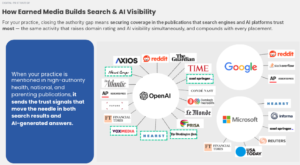
The reason for this shift comes down to how AI platforms actually build their answers. Traditional search engines rank pages based on signals like backlinks and site structure, but generative AI models learn narratives instead. They draw on press coverage, community discussion, and third-party sources to determine what people are already saying about a business, then repeat that consensus back to users asking for a recommendation.
According to Inc., Gartner predicts earned media budgets will double by 2027, driven by AI replacing traditional search as the primary way people discover brands. The article notes that roughly 94 percent of links cited in AI-generated answers come from non-paid sources, and half of all AI citations draw from content published within the last 11 months. Recency and credibility now matter more than volume or spend.
Fernandez confirmed that this thinking shapes how her team approaches every new client relationship. “It is truly the core of what we think about in our first conversation with a potential client,” she said. “We audit their current AI visibility, how they show up across platforms like ChatGPT and Claude, and how that compares to their competitors. If a client has zero AI visibility while their competitors have thousands of mentions, that becomes a key part of how we frame our strategy. It wasn’t like that two years ago, but right now, it starts and ends with AI.”
 A Real Campaign Shows What This Looks Like in Practice
 A Real Campaign Shows What This Looks Like in Practice
We saw this play out directly with Setareh Law, a personal injury firm we partnered with on a New Year’s Eve safety campaign in California. The idea was simple: offer free Uber rides home to reduce impaired driving during one of the most dangerous nights of the year. Setareh Law funded over 700 vouchers and promoted the offer through a dedicated landing page.
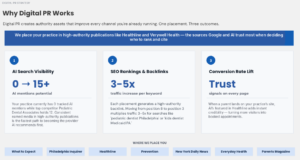
The campaign earned 33 media features and six television segments across outlets including Yahoo News, MSN, KTLA, and NBC affiliates throughout California. Fernandez described why campaigns like this do double duty. “It is not only a search increase, a traffic increase to their website, but we also saw branded search increase, and keyword rankings that were not in the top 10 suddenly were, because getting a boost of credible sources referring to you as a trusted authority moves the needle on search,” she said. For Setareh Law, that boost translated into a 133 percent increase in Google AI Overview citations over six months and a 101.3 percent increase in branded search clicks, with the firm’s Beverly Hills personal injury keyword ranking climbing into the top three results.
Recency and Consistency Matter More Than a Single Big Hit
One detail from Fernandez’s team stood out as especially important for planning ahead. AI models favor content published within the past year, so a placement from three years ago carries far less weight today. “You can say you were in a major publication years ago, or that you built links a while back, but that doesn’t matter as much right now because timeliness is important,” Fernandez explained. “AI is looking for consensus. It wants to understand what credible sources are saying about a business, and if something is being said consistently, that is the information it pulls.”
That is why ongoing, consistent coverage works better than a single splash. Most of MMM’s PR clients receive media coverage every month rather than treating press as a one-time event. This steady drumbeat gives AI models the repeated, consistent signal they are designed to trust, supporting the long-term search visibility that a single campaign cannot sustain on its own.
AI Cannot Be Fooled by Paid Placements Dressed Up as Earned Coverage
A common misconception is that any kind of media mention will move the needle, including paid or sponsored content designed to look organic. Fernandez was direct about why that approach fails. “You can pay to have a sponsored article, but it is not going to fool AI,” she said. “AI knows how to distinguish information that is paid or sponsored from something that is earned, and that is what it is looking at.”
The Federal Trade Commission has published specific guidance for marketers on this exact issue, warning businesses against working with platforms that offer better rankings or visibility in exchange for payment without proper disclosure. According to McKinsey, roughly half of consumers now intentionally use AI-powered search tools to guide purchase decisions, and a brand’s own website often accounts for only a small share of the sources AI actually cites when building an answer. That gap between what a brand controls and what AI trusts is exactly where legitimate PR work closes the distance.
Some brands respond to this shift with hesitation, assuming PR is a branding expense rather than a growth investment. Fernandez has seen that misconception firsthand. “I think for a lot of brands, it is still an afterthought,” she said. “PR has always been what you invest in with whatever is left over after paid and search. But it is not only about reputation with your customers anymore. It is about your online reputation, and if you want more visibility, more traffic, and more clients, AI is sourcing that information from credible outlets. You cannot pay your way into that.”
Where Businesses Should Focus Their Investment Next
Building visibility inside AI-generated answers requires more than one strong campaign. It requires a mix of factors working together to build a consistent, credible presence across the sources AI already trusts.
- Outlet credibility: Coverage from established, recognizable publications carries more weight than mentions on low-authority sites or forums.
- Recency: Fresh coverage published within the past several months influences AI answers far more than older placements.
- Consistency: Multiple credible sources repeating the same core narrative about a business builds the kind of consensus AI models are designed to recognize.
- Authenticity: Coverage that is genuinely earned through real outreach and real stories carries weight that paid or sponsored content cannot replicate.
Businesses that build strategy around these four factors position themselves to show up where their future clients are actually looking, whether that is a traditional search result or an AI-generated recommendation.
Building a Strategy With Market My Market
The shift toward AI-powered search is not a temporary trend, and it rewards businesses that treat PR and SEO as a single, connected strategy rather than two competing budget lines. Market My Market brings both disciplines together under one roof, with a dedicated PR team that understands how earned coverage and search performance reinforce each other in practice, not just in theory.
Whether you are exploring your first press campaign or looking to strengthen your presence in AI-generated search results, our team can build a strategy around your goals and your market. Contact us to talk through where your business currently stands and what a combined PR and SEO approach could look like for your growth.